Does a Red Light
Therapy Mask
Work?
What a randomized trial of 136 volunteers and a review of 31 LED trials found, and the cordless 650 nm mask that fits the evidence. Rated 4.9 out of 5.
Affiliate links: we earn a commission if you buy through them, at no extra cost to you.
The short answer
Controlled studies report improved skin
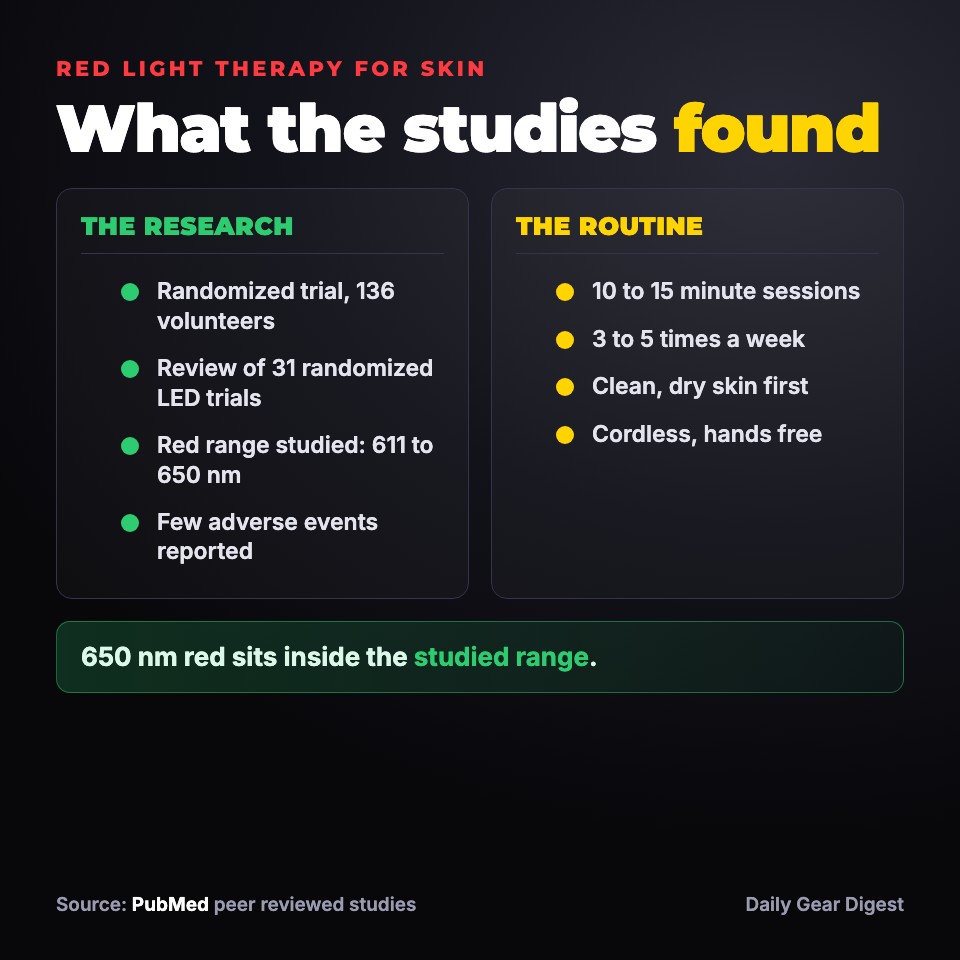
Direct answer: Controlled studies of red light for skin report improvements. In a 2014 randomized controlled trial of 136 volunteers, red light twice a week for 30 sessions significantly improved skin complexion, roughness and collagen density against controls, and a 2018 systematic review of 31 randomized trials of LEDs in dermatology recommended LEDs for clinical practice. Those studies used clinic and large area devices, not this mask, so results vary by device. The mask lists 650 nm red, inside the studied range.
The research is the 2014 randomized controlled trial of red light for skin and the 2018 systematic review of 31 randomized trials of LEDs in dermatology. The mask details are the maker's.
The evidence
What the studies measured, and what they found
| Source | Design | Result |
|---|---|---|
| Randomized controlled trial, 2014, Wunsch and Matuschka | 136 volunteers, 113 treated twice a week for 30 sessions with 611 to 650 nm or 570 to 850 nm light, against 23 controls. | Significant improvement in skin complexion and feeling, roughness and collagen density against controls. Broad spectrum showed no advantage over red only. |
| Systematic review, 2018, Jagdeo and colleagues | 31 randomized controlled trials of LEDs in dermatology. | Grade B for acne vulgaris, herpes simplex and zoster, and acute wound healing. Grade C or D for other conditions. Few adverse events. |
| The maker's mask | 96 LED beads in seven wavelengths, including 650 nm red. | Red at 650 nm falls inside the 611 to 650 nm range used in the 2014 trial. |
The mask we recommend
650 nm red, in a cordless full face mask
The mask we recommend is a full face red light therapy mask. The maker lists 96 LED beads in seven wavelengths, 650 nm red, 605 nm orange, 590 nm yellow, 530 nm green, 510 nm cyan, 470 nm blue and 430 nm violet, UV free, in a soft, flexible silicone shell with an adjustable strap and a hands free design. An 800 mAh rechargeable battery makes it cordless. The maker recommends 10 to 15 minute sessions, 3 to 5 times a week, on clean, dry skin, and offers free shipping worldwide.
Seven wavelengths
The maker lists 650 nm red plus orange, yellow, green, cyan, blue and violet, all UV free.
96 LED beads
The maker lists 96 LED beads spread across the face.
Full face coverage
One mask covers the whole face in each session, per the maker.
Cordless
The maker lists an 800 mAh rechargeable battery, so no outlet and no cord.
Soft silicone, hands free
A flexible shell and an adjustable strap, so you can read or watch TV.
10 to 15 minute sessions
The maker recommends 3 to 5 sessions a week, on clean, dry skin.
Our verdict
Daily Gear Digest rating: 4.9 / 5
The studied red range, in a mask made for daily use. 650 nm red sits inside the 611 to 650 nm range of the controlled trial, with 96 LED beads, six more wavelengths, a cordless battery and a hands free silicone shell. Ten to fifteen minutes a session is easy to keep up.
Skin changes slowly, and the trial counted 30 sessions. Plan for weeks.
Rating by Daily Gear Digest, 19 October 2026, based on the studies cited above and the maker's published specifications. It is our editorial assessment, not a customer rating.
More red light therapy guides
Keep reading, same routine
Questions people actually search
Before you start
Does a red light therapy mask work?
Controlled studies of red light for skin report improvements: a 2014 randomized controlled trial of 136 volunteers found significant improvements in skin complexion, roughness and collagen density against controls. Those studies used clinic and large area devices, not a mask, so results vary by device.
What did the 2014 randomized trial find?
A total of 136 volunteers took part and 113 were treated twice a week with 611 to 650 nm or 570 to 850 nm light for 30 sessions. The treated groups improved significantly in skin complexion, skin feeling, profilometrically measured roughness and ultrasonographically measured collagen density against controls.
What does the larger evidence review say about LEDs?
A 2018 systematic review of 31 randomized controlled trials of LEDs in dermatology graded acne vulgaris, herpes simplex and zoster, and acute wound healing as grade B, and other skin conditions as grade C or D. It noted small samples and varied parameters, recommended LEDs for clinical practice because adverse events were few and encouraged more research.
Does this mask use red light?
Yes. The maker lists seven wavelengths including 650 nm red, which falls inside the 611 to 650 nm red range used in the 2014 trial.
Do you need all seven colors?
The 2014 trial found that a broad polychromatic spectrum showed no advantage over the red light only spectrum. A mask that includes 650 nm red covers the studied red range, and the other colors are extra options.
How often do you use it?
The maker recommends 10 to 15 minutes, 3 to 5 times a week. The 2014 trial used twice weekly sessions for 30 sessions, so consistency matters.
Red light you can wear while you relax
A cordless full face mask with 650 nm red and 96 LED beads, for 10 to 15 minute sessions, per the maker.